



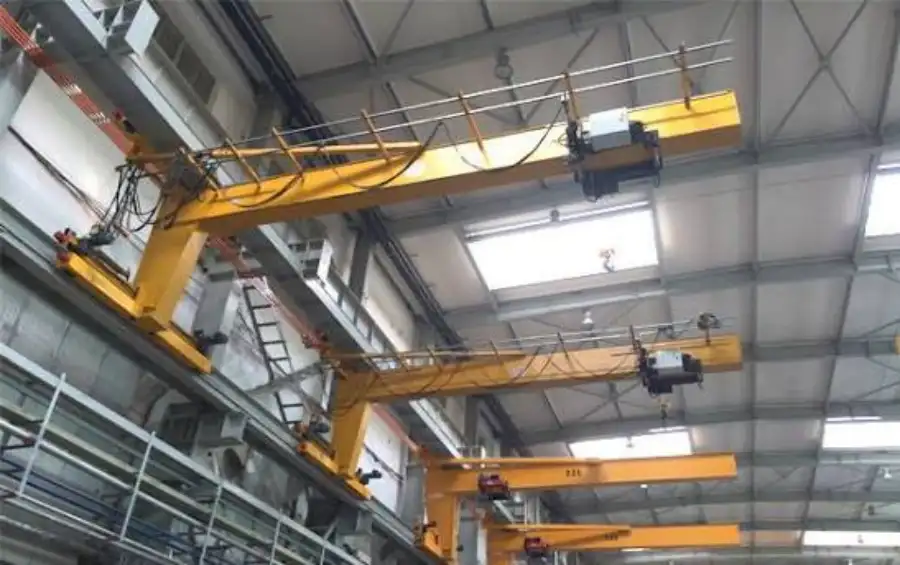
A wall rail jib crane is a jib crane on rails. Instead of a bracket bolted at one point, the jib hangs from a carriage that rolls along a runway fixed to the building columns or wall beams; the hoist travels the jib, and the jib slews on the carriage. Long travel, cross travel and hoisting combine into a rectangular working area — runway length × jib outreach. A fixed wall jib owns one arc; a wall rail jib owns the wall.
Weihua builds this configuration as its BB type for machine shops and multi-layer assembly bays, where work moves from station to station along a wall with the floor kept clear.
The Carriage Is Where the Design Gets Hard
A fixed wall jib carries a static load at one point on the wall. Here nothing is static. As the carriage advances, wheel loads move from bracket to bracket, and the cantilevered jib keeps trying to tip it about the runway. That tipping moment is what the carriage must resist, and it is where BB designs differ most between suppliers. The usual solution is a second, lower rail with a counter-roller, so the moment resolves as a couple between upper and lower wheels instead of loading one bracket.
Three consequences follow:
-Reactions arrive at every column. The drawing should give the load at each bracket along the runway — vertical, lateral and moment — so your structural engineer can check the columns individually. A total-load figure is not designable.
-The runway has to be straight end to end. A short jib arc forgives a few millimetres of bracket misalignment; a 40 m runway does not, and columns are rarely cast to crane tolerance. Expect to shim and grout the brackets.
-Travel is the hard-working motion. Send the hoist inboard before travelling; running the carriage with the load at full outreach multiplies wheel loads and rail bending for no gain.
Wall Rail Jib Crane vs a Row of Fixed Wall Jibs
Price the alternatives on the same wall. Fixed wall jibs at four stations mean four brackets, four hoists, four cable runs and four inspection points. One travelling jib serves all four with a single hoist, so cost per station falls as the line lengthens: a 5 m jib on a 40 m runway covers roughly 200 m² of wall-side working area while taking no floor space at all.
Two limits shape that area. The jib cannot reach the strip directly beneath its own runway, because that is where the carriage and rail sit. And the hook can never rise above the jib, so the runway elevation fixes maximum hook height for the whole line: set it from the tallest machine you serve, not the average. Travel speed then decides whether the operator waits for the crane or the crane waits for the operator.
The second advantage is where it sits: below the overhead bridge crane runway. Heavy workpieces stay with the EOT crane, while this one takes the light, high-frequency lifts — loading a machine tool, moving a fixture, presenting a part at assembly. Two cranes, one bay, no interference, and the main crane stops making short trips.
When It Is the Wrong Answer
One or two stations. A fixed wall jib needs no runway and costs less.
No wall or column. A free-standing pillar jib brings its own foundation.
Heavy or long workpieces. That belongs to the overhead crane.
Slender columns in an old shed. Reinforcement can cost more than a free-standing jib. Price both.
Two Moving Joints, Two Power Problems
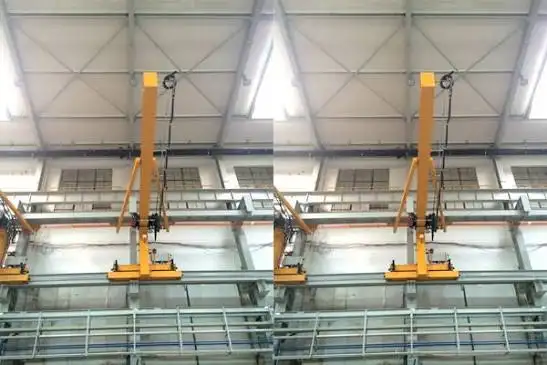
A fixed wall jib has one movable joint to feed; this one has two, moving independently: the carriage along the runway and the jib slewing on it. The runway run is the long one, and sag, snagging and contact wear all scale with its length. The slew joint is the other half: the cable has to follow the jib through its arc without being twisted by the rotation. Draw the power route before the runway is bolted to the columns; correcting it later means working around the building.
What the Supplier Needs From You?
Nearly all the engineering risk sits at the interface, so the input list is about your building:
-Column or steelwork drawings, and which members the brackets may use
-Column spacing, runway length, and the elevation the rail can sit at
-Capacity at the worst outreach, plus hook height needed at each station
-Duty class, expected lifts per hour, and travel speed between stations
-Supply voltage and frequency — 3-phase 380 V/50 Hz is standard, other supplies on request
What comes back should include a bracket reaction table for your structural engineer, a runway layout, and a price separating crane, hoist and runway hardware. The brackets and rail are the items most often left vague, and they depend on your building rather than the crane supplier. Settle who aligns and grouts the rail.
Frequently Asked Questions
What is the difference between a wall rail jib crane and a wall-mounted jib crane?
A wall-mounted jib bolts to the wall at one point and only slews, so its coverage is a single arc. A wall rail jib carries the same jib on a carriage that travels a runway along the wall, so one crane reaches every station on that wall. Past two or three stations, the travelling version usually costs less in total than the row of fixed jibs it replaces.
Does a wall rail jib crane need a foundation?
No floor column and no concrete block, which is its main advantage. The runway and its brackets load the building's columns or steelwork instead, and those members have to be checked against the wheel loads and bracket reactions the supplier issues with the drawing.
What sizes and working conditions are typical?
These are light-to-medium duty cranes, commonly A3–A5, with a 380 V/50 Hz three-phase supply and a standard ambient range of −20 °C to +45 °C. Capacity, jib outreach and lifting height are engineered against your runway and column data rather than picked from a catalogue, so confirm the figures against your own building.
Can it be installed under an existing overhead crane?
Yes, and that is one of its most common applications. It mounts on the columns below the bridge crane runway and takes the light lifts at the machines, leaving the overhead crane free for heavy workpieces. Check that the rail elevation clears both the machine tools and the bridge crane's lowest travel position.
What should be in the quotation for a wall rail jib crane?
Crane, hoist and runway hardware as separate lines, a reaction table for each bracket position for your structural engineer, the rail specification, and the power route drawing for both the travel and slew joints. The runway items are worth checking line by line, because they are sized to your building rather than to a standard product.
