



What Exactly Is a Marine Boat Hoist?
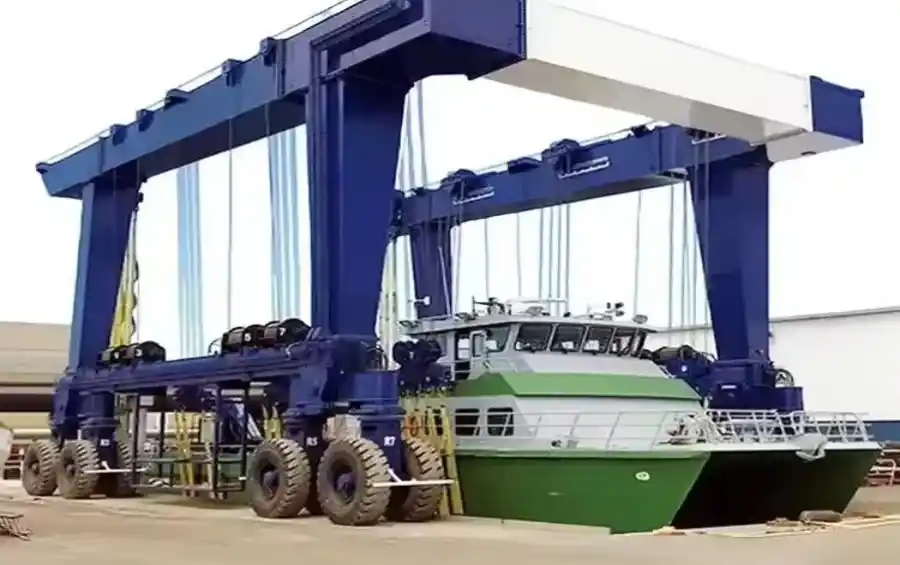
A Marine Boat Hoist is a mobile lifting machine built to handle boats and yachts.
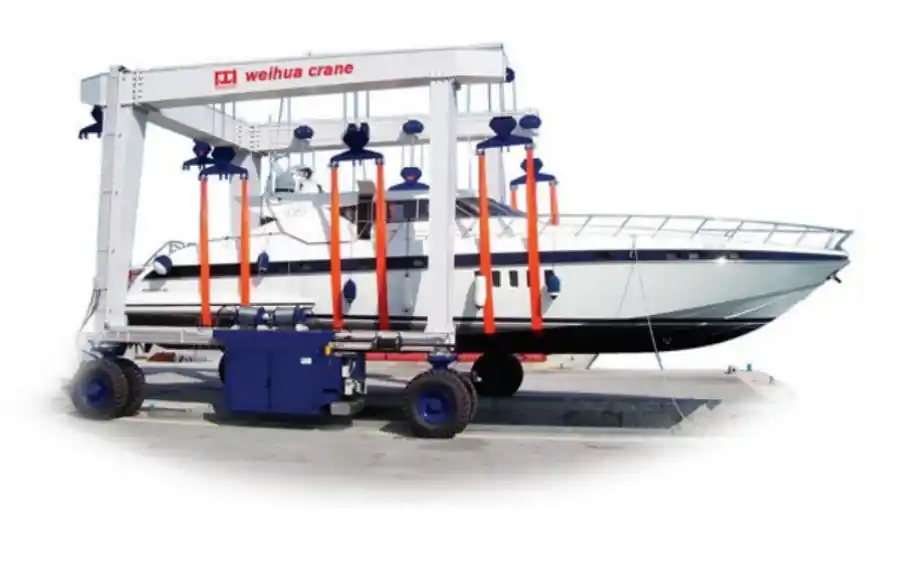
Unlike a standard industrial crane that normally lifts from a fixed hook point, a boat hoist usually works with multiple lifting slings positioned underneath the hull. This allows the vessel weight to be distributed across suitable supporting areas instead of being concentrated at one point.
The hoist typically travels on its own wheels, so after lifting the boat from a launching or hauling area, the operator can move the vessel directly to another location inside the yard.
This makes it especially practical when one machine needs to perform several tasks:
-Boat launching and retrieval
-Yacht hauling
-Hull inspection
-Engine or mechanical maintenance
-Bottom cleaning and painting
-Winter storage
-Boat manufacturing and assembly
-Moving vessels between workshop and storage areas
The main value is not simply lifting capacity. It is the ability to lift, carry, position, and release a boat with controlled support of the hull.
Why Boat Yards Use a Dedicated Boat Hoist?
A marina may handle fishing boats in the morning, sailing yachts in the afternoon, and larger motor yachts later in the week.
These vessels can have very different hull shapes, lengths, beam widths, weights, keels, propellers, shafts, and underwater fittings.
A general-purpose crane may be able to lift some of them, but the lifting arrangement can become complicated. Additional transport equipment may also be needed after the boat is placed on land.
A Marine Boat Hoist is intended to simplify this process.
The operator can arrange the lifting slings according to the boat structure, raise the vessel, move it through the yard, and lower it onto supports or maintenance stands.
For yards handling different vessels every day, this flexibility is often more important than maximum lifting capacity alone.
Sling Positioning Matters More Than Many Buyers Expect
The lifting slings are one of the most important parts of the entire boat-handling process.
They must support the vessel in appropriate locations while avoiding sensitive areas such as propellers, shafts, stabilizers, transducers, or other underwater equipment.
For yards handling different vessels, adjustable sling positioning provides much greater operating flexibility.
Before lifting an unfamiliar boat, the operator should know the correct lifting zones. These may be marked on the hull or specified by the vessel manufacturer.
This is especially important for yachts with complex underwater equipment.
The Marine Boat Hoist provides the lifting capability, but correct sling placement is what helps transfer the vessel load safely into the lifting system.
Think About Your Yard Layout Before Choosing the Machine
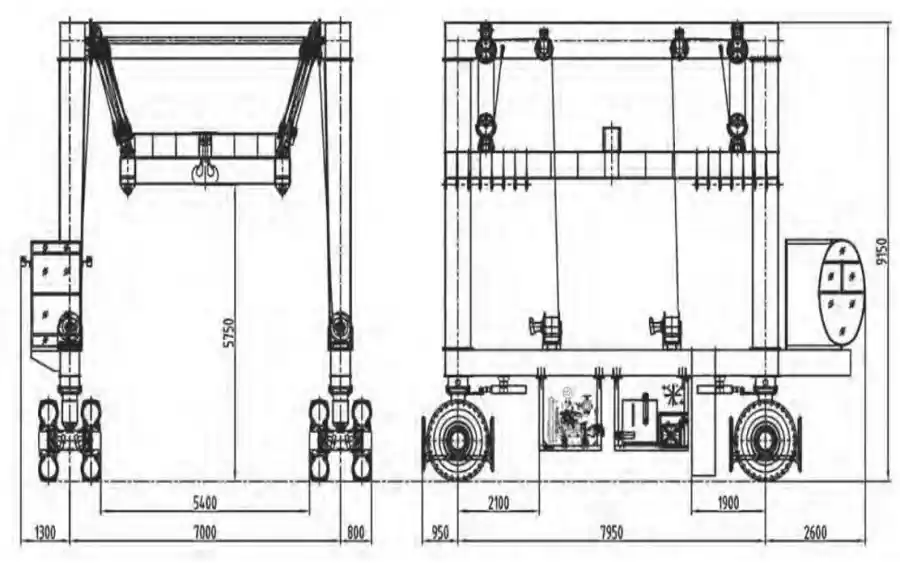
A suitable Marine Boat Hoist must work not only with the boat but also with the site.
Before purchasing, check the complete travel route from the water to the final storage or maintenance position.
Important dimensions include:
Launching area width
Can the hoist approach and straddle the vessel without interference?
Travel lane width
Is there enough space for the machine to move between buildings, stored boats, fences, or other equipment?
Turning area
Can the hoist maneuver where required?
Ground condition
The travel surface must be suitable for the equipment and expected operating load.
Workshop entrance
If boats need to enter an indoor maintenance building, doorway dimensions may become a major limitation.
Storage spacing
The selected hoist should support the way boats are arranged in your yard.
A large lifting capacity is not useful if the machine cannot move efficiently through the working area.
Steering Is Important in Crowded Marinas
Marine service yards often have limited space.
Boats may be parked closely together, while workshops, docks, storage areas, and access roads restrict movement. For this reason, maneuverability should be discussed during equipment selection.
Do not evaluate steering only from a specification sheet.
Instead, explain how you expect the hoist to move:
-Straight from the slipway to the yard
-Around tight corners
-Between stored vessels
-Into a maintenance area
-Through narrow access lanes
-Toward different storage positions
A supplier can then recommend a suitable steering configuration based on the actual operating route.
The objective is simple: the hoist should fit your yard operation, not force you to redesign the entire yard around the machine.
Lifting Speed and Travel Speed Should Match Real Work
Boat handling is normally about control rather than speed.
During lifting and lowering, operators need smooth movement so they can monitor sling position and vessel clearance.
Travel speed is also usually less important than stable, predictable movement through the yard.
When comparing Marine Boat Hoist options, consider the complete handling cycle:
1.Position the hoist.
2.Arrange the slings.
3.Lift the vessel.
4.Move it away from the water.
5.Transport it through the yard.
6.Position it over supports.
7.Lower and release the slings.
A machine that performs this process smoothly and efficiently can be more valuable than one selected only because a single specification looks impressive.
What Information Should You Send for a Quotation?
A good Marine Boat Hoist quotation should be based on your real vessel and site information.
Sending only a message such as:
“Please quote a 100-ton boat hoist.”
is usually not enough for proper equipment selection.
A more useful inquiry includes:
-Maximum boat weight
-Maximum boat length
-Maximum beam
-Approximate boat height
-Hull and keel type
-Required lifting location
-Required travel distance
-Ground or yard conditions
-Available operating width
-Main application
-Typical number of lifting operations
-Any site restrictions
-Photos or drawings of the dock and yard if available
If you handle several boat types, send information for the smallest, typical, and largest vessels.
This gives the supplier a much better understanding of the operating range.
Questions Worth Asking Before You Buy
When comparing Marine Boat Hoist suppliers, do not focus only on price and rated capacity.
Ask how the proposed machine fits your actual operation.
Useful questions include:
Can the hoist accommodate my maximum boat beam?
How will sling positions be adjusted for different vessel lengths?
What information is needed to confirm the correct lifting arrangement?
How much operating space does the machine need?
What steering arrangement is recommended for my yard layout?
What site conditions should be prepared before delivery?
What maintenance points should operators check regularly?
What drawings and technical documents will be provided before production or delivery?
The quality of these discussions can tell you a lot about whether the supplier understands marine lifting or is simply offering equipment based on capacity.
A Better Way to Compare Marine Boat Hoist Offers
When several suppliers send quotations, put the technical information side by side.
Compare the equipment based on the same operating requirement instead of only comparing the final price.
Check whether each proposal is based on:
-The same maximum lifting weight
-The same vessel beam
-The same required clearances
-The same operating environment
-The same handling application
-Comparable documentation and service scope
If two quotations are based on different assumptions, the prices cannot be compared properly.
Clarifying the technical scope first can prevent expensive changes later.
What Makes a Marine Boat Hoist Suitable for Your Operation?
There is no single specification that makes one Marine Boat Hoist suitable for every marina or shipyard.
A yacht repair center with limited maneuvering space has different priorities from a boat manufacturer moving similar hulls every day.
A good solution should answer four practical questions:
Can it lift the heaviest vessel you need to handle?
Can it physically fit around the widest and tallest vessels?
Can it move safely through your yard?
Can the sling arrangement adapt to the boats you actually service?
If these four questions are answered clearly, equipment selection becomes much easier.
