



When a workshop needs overhead lifting but floor space is limited, a Suspension Single-girder Bridge Crane can be a practical solution.
Unlike floor-supported crane systems, this type of crane is suspended from the building roof structure or an independent overhead supporting structure. The runway is installed above the working area, allowing the crane to move loads without occupying valuable production space with columns or ground rails.
This makes it especially suitable for factories, assembly areas, maintenance workshops, warehouses, and production lines where operators need frequent lifting within a defined working zone.
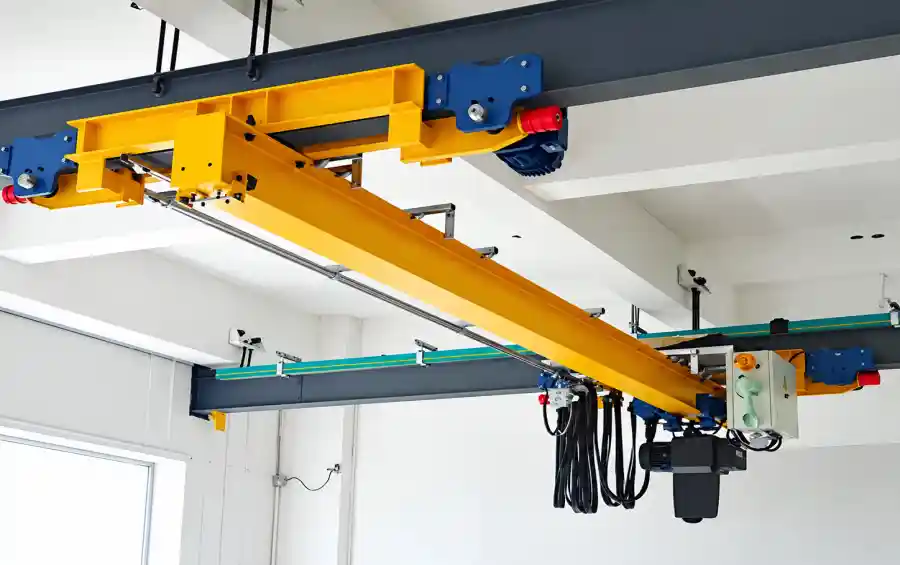
What Is a Suspension Single-Girder Bridge Crane?
A Suspension Single-girder Bridge Crane uses one main bridge girder combined with an electric hoist or other lifting mechanism.
The crane bridge travels along suspended runway beams, while the hoist moves horizontally along the main girder. Together, these movements allow materials to be lifted and transported across the crane coverage area.
The main operating motions normally include:
-lifting and lowering the load;
-hoist travel along the bridge girder;
-crane travel along the suspended runway.
Because the crane runs below the supporting structure, it is often described as an under-running or underslung overhead crane.
The biggest advantage is simple: the lifting system stays overhead, leaving the floor available for machines, workstations, material storage, forklifts, and personnel.
Where Does This Crane Make Sense?
A Suspension Single-girder Bridge Crane is particularly useful when installing conventional floor-supported runway columns would interfere with production.
For example, consider an assembly workshop with several machines positioned close together. Adding crane columns between the machines may reduce aisle width and create obstacles for forklifts. A suspended crane system can use the available overhead structure instead.
Typical applications include mechanical workshops, component assembly lines, equipment maintenance areas, warehouses, fabrication shops, production cells, and material transfer stations.
It can also be useful in buildings where lifting is required only in a specific production section rather than across the entire workshop.
In these situations, customers are usually not looking for the highest possible lifting capacity. They are looking for efficient coverage, simple operation, compact installation, and better use of available floor space.
Why Choose a Single-Girder Suspended Design?
The single-girder configuration keeps the crane structure relatively compact.
For appropriate lifting capacities and spans, it can provide several practical benefits.
First, the overall crane weight can be lower than a comparable double-girder system. This is important because the supporting roof or steel structure must carry the crane loads.
Second, a compact crane can reduce the amount of overhead space required for installation.
Third, the system is generally simpler in terms of structure and maintenance.
However, this does not mean a single-girder suspended crane is automatically suitable for every workshop.
The supporting structure, crane span, lifting capacity, duty requirement, hook approach, lifting height, and operating frequency all need to be considered before the crane configuration is confirmed.
The Building Structure Is One of the First Things to Check
For a Suspension Single-girder Bridge Crane, the supporting structure is a critical part of the project.
Before purchasing the crane, the customer should confirm whether the existing building structure is suitable for supporting suspended crane loads.
This is different from a crane running on independent floor-supported columns.
The suspended runway transfers vertical loads and other operating forces into the overhead supporting structure. For this reason, the building drawings, beam arrangement, connection points, and available installation space should be reviewed during project planning.
If the existing structure cannot support the crane directly, an independent supporting steel structure may need to be considered.
This structural condition should be discussed early. It can affect the crane design, installation method, project cost, and delivery scope.
Lifting Height Is Not Just the Distance from Floor to Roof
Customers often say, “My workshop height is 8 meters. What lifting height can I get?”
The actual answer depends on the crane arrangement.
The usable lifting height is influenced by the runway elevation, crane girder depth, hoist dimensions, hook position, required safety clearances, and the height of the load itself.
For applications where every millimeter of vertical space matters, the hoist arrangement and crane headroom should be reviewed carefully.
When requesting a quotation, it is better to provide the required hook lifting height instead of only providing the total building height.
For example, tell the crane supplier the maximum height from the floor to the hook when the hook is fully raised, as well as the lowest working position required.
That information is much more useful for crane selection.
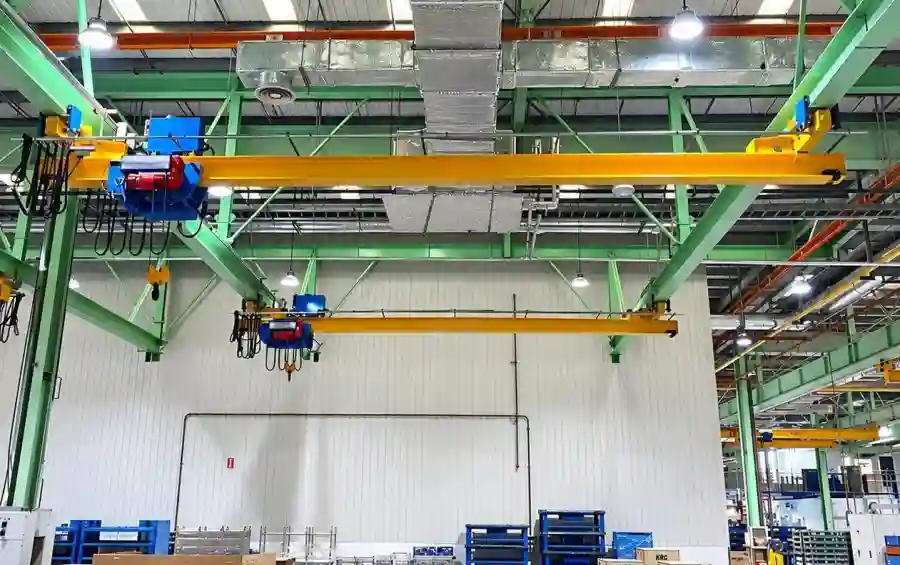
How to Select the Right Suspension Single-Girder Bridge Crane?
A good crane quotation starts with the actual lifting task, not just capacity and span.
Suppose you need to lift a 3-ton component. The crane cannot be selected correctly from “3 tons” alone.
The supplier also needs to know how often the component is lifted, how far it travels, whether the crane operates occasionally or continuously, the dimensions of the load, and the available space inside the workshop.
Several points should be confirmed before placing an order:
Required lifting capacity
Use the maximum actual load that the crane must handle. Include lifting attachments if they form part of the lifted load.
Crane span
The span is related to the distance between the crane runway systems. Accurate building dimensions are important because the final crane geometry depends on the installation arrangement.
Runway length
This determines the longitudinal travel distance and the working coverage of the crane.
Required lifting height
Specify the working hook height rather than only the building height.
Duty and operating frequency
A crane used several times per day has different requirements from one used continuously during a production shift.
Material being lifted
Steel components, molds, machinery, fabricated parts, packaged goods, and maintenance equipment may require different lifting arrangements.
Control method
Depending on the application, crane operation may use pendant control, remote control, or another suitable control arrangement.
Power supply
Provide the available local voltage, frequency, and phase information when requesting a quotation.
Pay Attention to the Crane Working Area
One advantage of a suspended crane is its ability to serve a defined work zone efficiently.
However, the real hook coverage should be checked instead of assuming the hook reaches every point beneath the runway.
The crane has physical dimensions at both ends, and the hoist also has approach limitations near the girder ends.
If the crane must pick up materials very close to a wall, machine, production line, or storage rack, provide those dimensions to the supplier.
A simple workshop layout showing columns, walls, machines, runway location, and required pickup points can prevent many design problems.
This is especially important when the crane is being installed into an existing factory.
Suspension Crane or Top-Running Crane?
Both designs are used for overhead material handling, but they solve different installation problems.
A suspended crane travels below its runway structure. It is often considered when the building layout makes floor-supported columns undesirable or when an overhead supporting structure is available.
A top-running crane travels on rails mounted above the runway beams. It is commonly used for larger spans, higher capacities, or installations with dedicated crane runway structures.
The correct choice depends on the building, load, operating conditions, and required working envelope.
It is better to select the crane according to the application rather than choosing a crane type first and trying to make the workshop fit the crane afterward.
