



Handling molten metal is one of the most demanding lifting jobs inside a steel plant or foundry.
The load is hot, the working area is harsh, and every movement needs to be controlled. A crane used for general workshop lifting is not automatically suitable for ladles, molten steel, or casting operations.
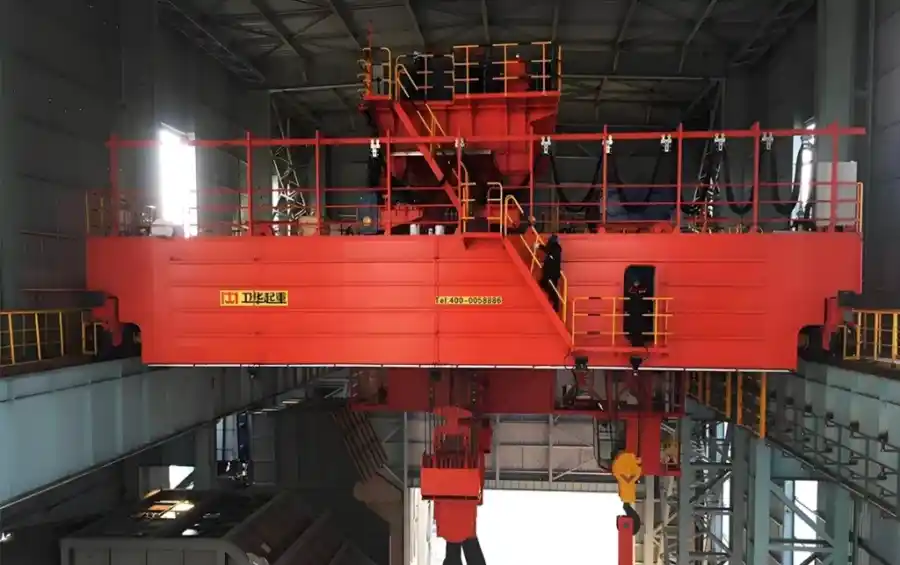
This is where a Foundry Casting Crane is used.
It is designed for lifting and transferring molten metal during smelting, refining, pouring, and casting processes. For buyers, the key point is not simply how many tons the crane can lift. The real question is whether the crane configuration matches the actual foundry process, ladle arrangement, operating frequency, heat conditions, and required safety level.
Where a Foundry Casting Crane Fits Into the Production Process?
A Foundry Casting Crane normally works around furnaces, ladles, casting areas, and related production stations.
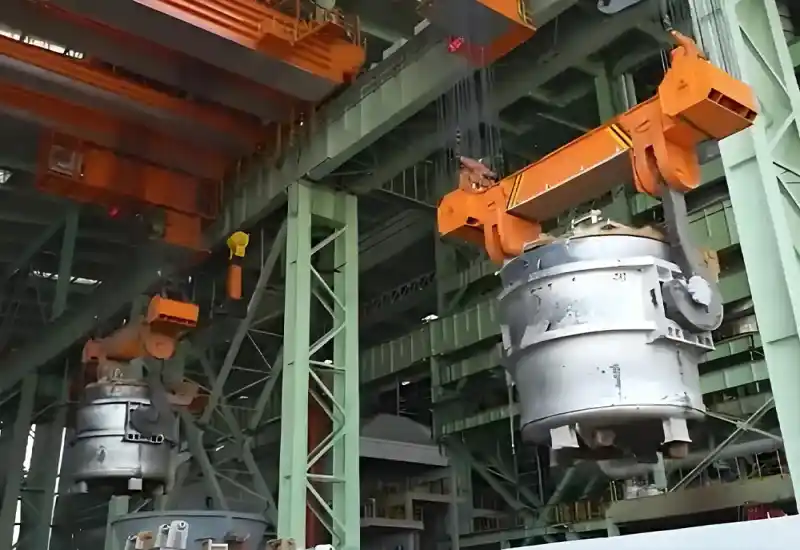
Its job may include lifting a filled ladle, moving molten metal from the furnace area, positioning the ladle above a casting point, or supporting pouring operations.
In many plants, the crane becomes a direct part of the production flow.
That means crane selection should start with the actual route of the molten metal.
A useful layout discussion should answer questions such as:
-Where is the ladle picked up?
-How far does it travel?
-What is the maximum lifting height?
-Does the ladle only need vertical lifting and travelling, or also controlled tilting and pouring?
-Are there obstacles, platforms, furnaces, ducts, or equipment below the crane?
-How frequently does the crane repeat the same cycle?
These details are much more important than choosing a crane from a standard capacity table.
The Load Is More Than Just the Weight of Molten Metal
One common mistake during inquiry is to provide only the weight of the liquid metal.
For crane selection, the total lifted load should be considered.
This can include the ladle itself, molten metal, hooks, spreader beams, lifting beams, or other below-the-hook equipment.
For example, if the metal weighs several tons but the ladle and lifting device add significant weight, the crane must be selected according to the complete suspended load, not just the liquid metal.
When requesting a quotation for a Foundry Casting Crane, it is better to provide:
-empty ladle weight
-maximum molten metal weight
-weight of lifting attachments
-maximum total lifted load
This gives the supplier a much clearer basis for crane design.
Why Foundry Duty Is Different From Normal Workshop Duty?
A crane in a foundry usually works under more severe conditions than a general-purpose overhead crane.
High ambient temperature is an obvious difference, but it is not the only one.
There may also be dust, fumes, radiant heat, frequent starting and stopping, long working shifts, and repeated heavy-load cycles.
The crane may need to work close to furnaces or directly above areas with intense thermal radiation.
Because of this, the electrical equipment, motors, cables, control system, braking arrangement, lifting mechanism, and operator protection all need to be considered according to the real environment.
If the crane works continuously in production, duty conditions become especially important.
A crane designed for occasional lifting should not be treated as equivalent to equipment working through multiple shifts in a metallurgical process.
Ladle Handling and Pouring Are Not Always the Same Task
Not every Foundry Casting Crane performs the same operation.
Some cranes mainly transport ladles from one production station to another.
Others are more directly involved in pouring.
If the crane also needs to tilt or rotate the ladle during casting, the lifting arrangement may be more complex.
This is why buyers should clearly explain whether the crane only lifts the ladle or also assists with pouring.
It is useful to provide information about:
-ladle shape
-lifting lug arrangement
-trunnion position
-hook or lifting beam arrangement
-pouring method
-required tilting movement
-required positioning accuracy
Photos or drawings of the existing ladle can be very helpful during technical selection.
Crane Span and Plant Layout Need to Be Checked Together
The crane span is determined by the workshop and runway arrangement, but foundry plants often have more complicated layouts than ordinary factories.
There may be furnace structures, platforms, exhaust systems, pipelines, casting machines, or high-temperature zones near the crane runway.
For this reason, the overall workshop drawing is important.
Before quotation, buyers should ideally provide:
-workshop width
-crane runway span
-rail elevation
-available headroom
-highest equipment point below the crane
-required hook approach
-required lifting height
-building column spacing
-crane travelling distance
These details help determine whether the crane can physically serve the required working area.
How Often Will the Crane Work?
This question is essential for a casting crane.
Some cranes may perform only a limited number of ladle transfers per shift. Others operate as part of a continuous production line.
Buyers should provide realistic operating information, such as:
-working hours per day
-shifts per day
-approximate lifts per hour
-average load
-maximum load
-typical lifting distance
-typical travelling distance
-percentage of operation at full load
This helps the supplier understand the actual duty of the crane.
For metallurgical lifting, working frequency can affect the selection of motors, reducers, brakes, wheels, controls, and other components.
New Foundry Project vs. Replacement Crane
The information needed for a new plant and a replacement crane is slightly different.
For a new project, the crane supplier can work from workshop drawings, production flow, ladle data, and required handling routes.
For a replacement Foundry Casting Crane, the existing runway and building become major constraints.
In that case, buyers should provide as much existing crane information as possible, including:
-current crane capacity
-existing span
-rail size
-runway elevation
-wheel arrangement if available
-crane overall dimensions
-hook approach
-lifting height
-power supply
-building drawings
-photos of the current crane and runway
This can help avoid compatibility problems during replacement.
What Information Is Needed for a Foundry Casting Crane Quotation?
A clear inquiry saves a lot of back-and-forth communication.
For an initial quotation, prepare the following information:
-maximum total lifting load
-empty ladle weight
-molten metal weight
-crane span
-lifting height
-crane travelling distance
-workshop dimensions
-rail elevation
-operating hours and shifts
-approximate lifting cycles
-ambient temperature
-distance from furnace or heat source
-indoor or outdoor installation
-power supply
-required control method
-whether ladle tilting or pouring assistance is required
-photos or drawings of the ladle
-workshop layout or crane runway drawing
If some information is not available yet, send the items you already know.
A sketch and several site photos can often answer many technical questions immediately.
How to Know If You Need a Dedicated Foundry Casting Crane?
If the crane regularly lifts molten metal, the project should be treated as a metallurgical lifting application from the beginning.
Do not choose a general-purpose overhead crane first and then try to adapt it later.
The lifting mechanism, controls, duty conditions, operating environment, and production process should all be considered together.
A suitable Foundry Casting Crane is not defined by capacity alone.
It is defined by how safely and reliably it can handle the actual ladle, in the actual workshop, at the required production frequency.
For a fast technical discussion, send the total ladle load, span, lifting height, travelling distance, working temperature, operating frequency, and workshop layout.
With these details, the crane can be selected around the real casting process rather than around a generic crane specification.
