



A QC electromagnetic bridge crane replaces the standard hook with a suspended electromagnetic disk. The operator can pick up and release ferromagnetic loads — scrap, billets, plates, ingots — without slings or ground crew. Three features separate it from a conventional QD hook crane:
•The nameplate capacity includes the disk weight.
•The electrical system includes a magnet control cabinet and a spring-driven cable reel that pays out slack as the disk moves.
•All standard QC models are rated A6 (heavy duty).
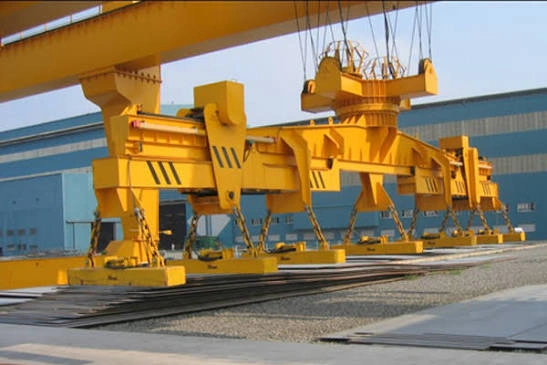
Two configurations exist. A single-disk QC crane (5–10 t, 16/3.2–20/5 t, 32/5–50/10 t) for bulk scrap and mill feeding. An electromagnetic carrier-beam crane (15 t / 7.5+7.5, 20 t, 32 t, 40 t) with multiple magnets on a cross beam for wide plates and long structural sections.
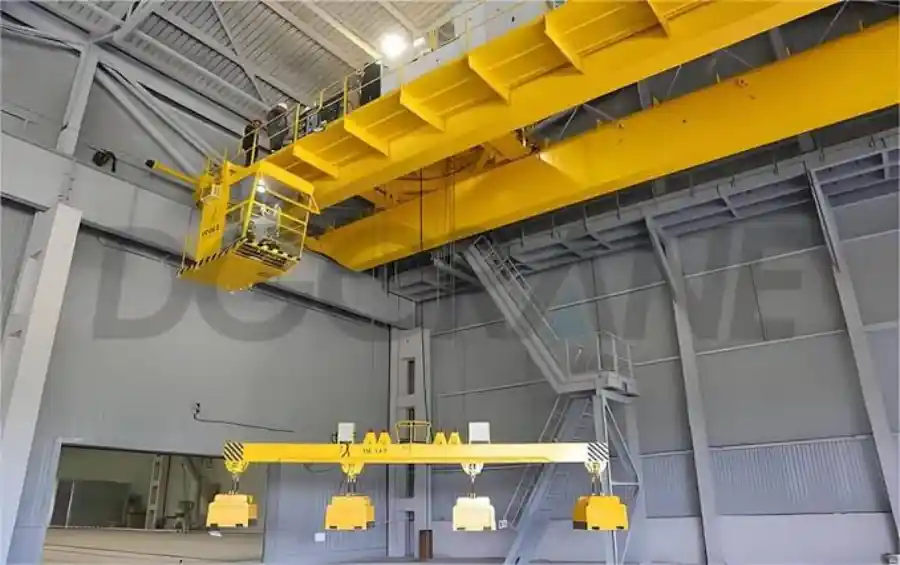
Electromagnetic Disk — Temperature, Cable, and Power-Loss Retention
Standard vs High-Temperature Magnet
Standard magnets handle material temperatures up to 100°C. For hot billets, forged ingots, or direct-from-oven scrap at 100–600°C, a high-temperature magnet with heat-resistant coil insulation is required. Specify this at the RFQ stage — standard and high-temperature magnets are not interchangeable.
Cable Routing
Power cable runs through a spring-driven reel on the trolley frame that automatically pays out and retracts as the disk moves. For low-lifting-height installations, a fixed cable basket on the carrier-beam can replace the reel at lower cost.
Power-Loss Retention
Without retention the magnet de-energizes instantly on power failure. A battery-backed system maintains the magnetic field and includes an inverter that lets the operator lower the load under power-off conditions. This is technically optional but effectively mandatory for any crane working over active areas.
Cab Entry Options
The QC crane cab can be entered from three directions. The choice affects yard layout around the bridge ends:
•Side entrance — via the bridge walkway. Standard layout.
•End entrance — via the end carriage platform. Used when the control cabinet or cable reel blocks the walkway.
•Top entrance — through a roof hatch. Used when side and end access are unavailable.
The cab mounts on either the left or right bridge end. Standard drawings show left-end mounting; this can be mirrored on request.
Magnet and Travel Controls
Magnet and travel are operated independently.
Magnet control — three push buttons in the cab: magnetize, demagnetize (polarity reversal to cancel residual magnetism), and emergency release. No variable settings — the magnet is either on or off.
Travel control — YZR wound-rotor motors. Two options: - Cam / contactor control — step-speed on-off. Lower cost, adequate where the magnet does not require precise approach. - VFD — stepless speed. Recommended where overshoot could damage the magnet or scatter material.
RFQ Parameters
The following seven items determine which QC model and magnet configuration the supplier will quote:
1.Rated capacity (t) — including the disk.
2.Span (m) — rail center to rail center.
3.Material type and temperature — standard ≤ 100°C or high-temperature 100–600°C.
4.Lifting height (m) — affects cable reel length.
5.Power supply — voltage, frequency, phase.
6.Power-loss retention — yes or no. If yes, battery duration.
7.Cab entrance — side, end, or top. Left or right mounting.
Frequently Asked Questions
Q1: What metals can an electromagnetic bridge crane lift?
Ferromagnetic metals: steel scrap, cast iron, billets, ingots, slabs, plates, structural sections, pipes, and bundled wire rod. Non-ferrous metals (aluminum, copper, stainless steel) cannot be lifted with a standard electromagnetic disk.
Q2: Does the nameplate capacity include the magnet weight?
Yes. Net payload = rated capacity – magnet weight. Ask the supplier for the specific disk weight at the quotation stage.
Q3: What happens if the power fails while the magnet is holding a load?
Without retention: the disk de-energizes and the load drops. With battery-backed retention (recommended for all cranes over live areas), the magnet holds and the inverter allows a controlled lower-to-ground.
Q4: Can the same crane switch between magnet and hook?
The disk is suspended from the hook and can be removed. The QC 16/3.2–20/5 t models with a dedicated auxiliary hook are more practical for regular switching between magnet and rigging work.
Q5: Single-disk QC crane vs electromagnetic carrier-beam crane — how to decide?
Single disk: bulk scrap, loose material, billets within reach of one disk. Carrier-beam (multiple magnets): wide plates, long structural sections, or loads spread across a large area.
