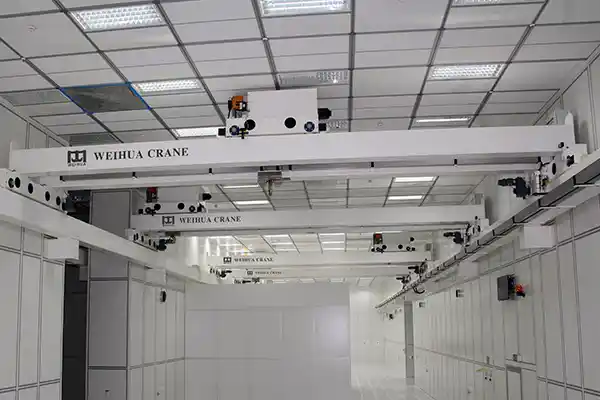
What Is a Cleanroom Overhead Crane?
A cleanroom overhead crane is an overhead lifting system designed for material handling inside environments where contamination must be carefully controlled.
Its basic working principle is similar to other overhead cranes: the bridge travels along runway beams, while the hoist and trolley move the load across the working area.
The difference is in the details.
A crane used in a normal workshop may tolerate exposed mechanical components, conventional lubrication methods, dust accumulation, or ordinary surface finishes. In a cleanroom, these details can become contamination risks.
A cleanroom crane therefore needs to be designed around the working environment as well as the lifting duty.
Depending on the project, attention may be given to areas such as:
-surfaces that are easier to clean;
-reduced particle generation from moving parts;
-suitable protection for electrical and mechanical components;
-controlled lubrication;
-enclosed or protected transmission components;
-smooth crane travel and hoisting;
-accurate load positioning;
-materials and finishes suitable for the required cleanroom conditions.
The exact configuration should always be selected according to the customer’s cleanroom requirements and production process.
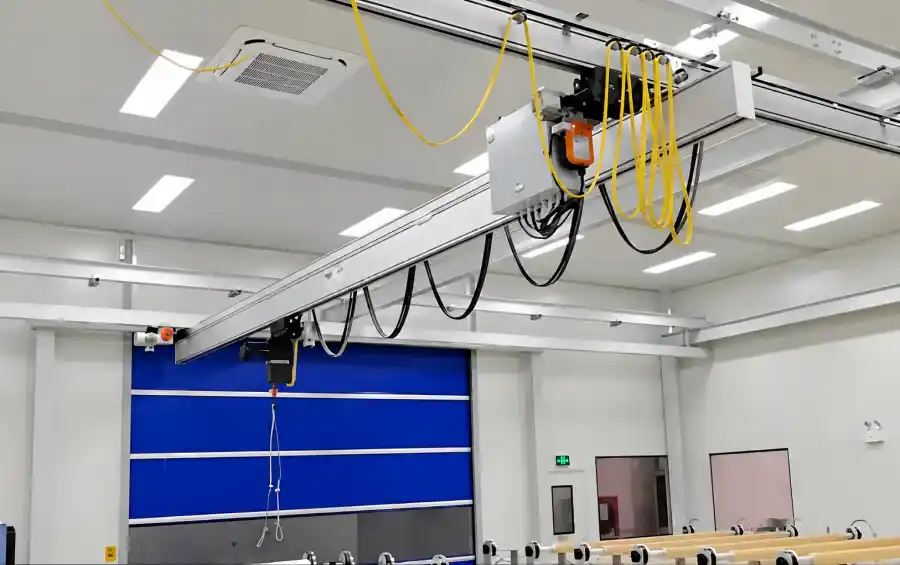
Where Is a Cleanroom Overhead Crane Usually Used?
Cleanroom lifting systems are mainly required where the product, process, or equipment is sensitive to contamination.
One common application is semiconductor production. Large components, manufacturing tools, precision assemblies, and process equipment may need to be lifted inside controlled areas where particles can directly affect production quality.
Another important area is pharmaceutical and biotechnology manufacturing. Here, lifting equipment may be used for production equipment installation, maintenance, material transfer, or handling operations in controlled processing areas.
Cleanroom cranes can also be considered for:
-electronics manufacturing;
-precision instrument production;
-medical device factories;
-optical equipment production;
-laboratories and research facilities;
-battery and advanced material production;
-controlled assembly rooms;
-other low-particle manufacturing environments.
The crane design should follow the actual process. A crane used mainly for machine installation may have very different requirements from one that performs repetitive production lifting every day.
Why a Standard Overhead Crane May Not Be Suitable?
Customers sometimes ask whether a normal overhead crane can simply be installed inside a cleanroom.
In some cases, standard crane components can be adapted. However, a conventional industrial crane is not automatically suitable for a controlled environment.
There are several reasons.
First, normal crane operation can generate particles through wheels, brakes, wire ropes, gears, cables, and other moving parts. The significance of this depends on the cleanroom requirement and where the crane is positioned in relation to the production area.
Second, ordinary lubrication can create concerns if grease or oil is exposed, leaks, or attracts contamination.
Third, conventional crane structures may include surfaces, corners, openings, or components that are difficult to clean.
Finally, standard crane control may not provide the smooth movement or positioning accuracy required when handling sensitive production equipment.
For this reason, the cleanroom requirement should be discussed at the beginning of the crane design process rather than treated as an optional modification after the crane has already been selected.
Hoist Selection Matters More Than Many Buyers Expect
The hoist is one of the most important parts of a cleanroom lifting system because it contains several components that move during every lifting cycle.
When discussing the hoist, consider how frequently it will operate and how accurately the load needs to be controlled.
A crane used occasionally for maintenance work is different from a crane operating continuously in a production process.
The supplier should know:
-how many lifts are expected per hour or shift;
-average load weight;
-maximum load weight;
-typical lifting distance;
-required lifting speed;
-whether slow-speed positioning is necessary;
-whether production depends on continuous crane availability.
This information helps determine a more appropriate hoist and duty configuration.
Smooth Travel Is Important in Sensitive Production Areas
In ordinary factories, slight load swing or abrupt crane movement may be acceptable.
Inside a clean manufacturing environment, it can become a bigger problem.
Sudden acceleration can cause the suspended load to swing. This makes positioning more difficult and can increase the risk of contact with nearby production equipment.
For sensitive handling operations, smoother travel is usually preferable.
Variable-frequency control can be considered for hoisting, trolley travel, bridge travel, or a combination of these motions depending on the project requirements.
The goal is not simply to make the crane “high-tech.” The goal is to make the movement easier to control during real production.
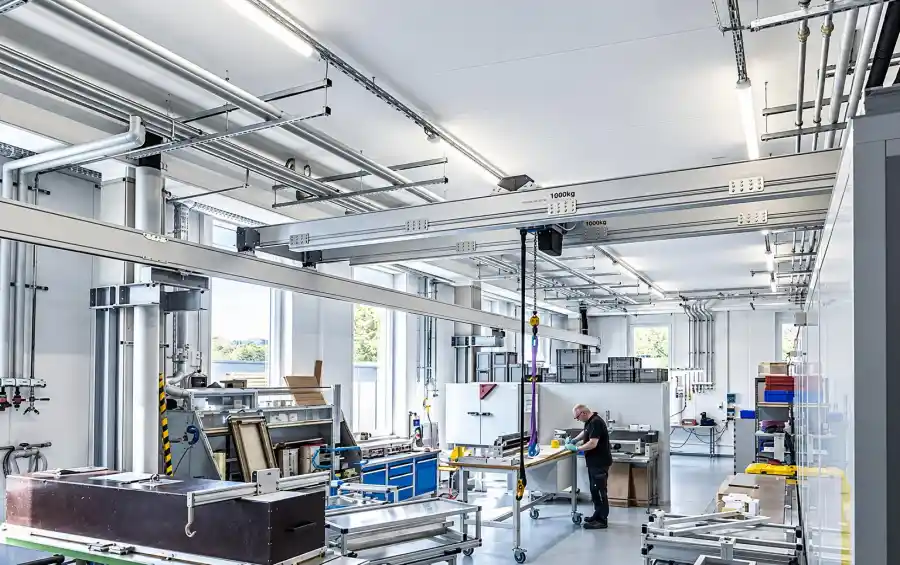
Pay Attention to the Crane Layout Above the Cleanroom
Many cleanroom crane projects become difficult because the crane is considered too late in the building design.
A cleanroom ceiling often contains filters, ventilation systems, lighting, utilities, cable routes, pipework, and process equipment.
The crane needs its own space as well.
Before confirming the crane arrangement, review:
-roof and ceiling clearance;
-runway beam position;
-filter and duct arrangement;
-hook approach;
-maintenance access;
-crane electrical routing;
-production equipment height;
-installation access.
A few centimeters of missing clearance can create major problems after construction has started.
For new facilities, it is much easier to coordinate the crane, building steel, cleanroom ceiling, and process layout at the design stage.
Questions Customers Often Ask
1.Can the cleanroom crane be customized for an existing cleanroom?
Yes, a cleanroom overhead crane can be designed around an existing facility, but the available space, runway condition, structure, ceiling layout, and installation method need to be reviewed first.
For retrofit projects, accurate dimensions are especially important.
2.Can I use the crane for precision equipment installation?
A cleanroom crane can be configured for equipment handling and installation, but the supplier needs to know how precise the final positioning must be.
For sensitive installation work, smooth low-speed movement and suitable lifting accessories may be more important than fast crane speed.
3.What capacity should I choose?
Do not select capacity only from the weight of the main machine.
Include the weight of lifting tools and accessories, and consider whether future equipment may be heavier.
If there is uncertainty, provide the actual load list to the crane supplier for review.
4.Is a cleanroom crane only used in semiconductor factories?
No.
Semiconductor manufacturing is an important application, but cleanroom cranes are also used in pharmaceutical, electronics, medical equipment, laboratory, precision manufacturing, and other controlled environments.
5.What determines the final crane price?
The quotation depends on the actual configuration.
Important factors can include lifting capacity, span, lifting height, runway length, crane type, cleanroom requirements, control system, operating duty, electrical configuration, installation conditions, and special lifting accessories.
A useful quotation therefore requires more than the capacity alone.
A Better Way to Choose a Cleanroom Overhead Crane
The best cleanroom crane is not necessarily the crane with the highest specification.
It is the crane that matches your production process without adding unnecessary complexity.
If your crane is mainly used to install production machines several times a year, your priorities may be lifting height, precise positioning, hook coverage, and safe access.
If the crane is part of daily production, operating frequency, smooth motion, maintenance planning, and reliability may become more important.
If ceiling space is very limited, headroom and structural layout may drive the entire crane design.
That is why a useful technical discussion should begin with the application rather than with a product model number.