



What Does a Warehouse Gantry Crane Actually Do?
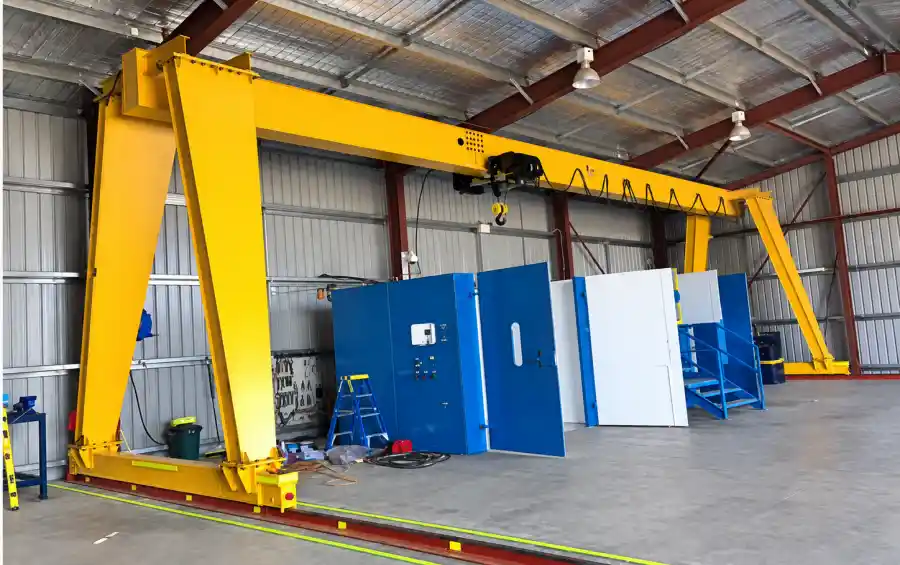
A warehouse gantry crane is designed to move loads vertically and horizontally within a defined working area.
A typical system includes a bridge beam, supporting legs, hoisting equipment, trolley system, and crane travelling mechanism. Depending on the design, the crane can travel along fixed rails or operate as a smaller movable gantry unit.
Inside a warehouse, it can be used for tasks such as:
-lifting machinery and equipment;
-moving steel, molds, components, or fabricated parts;
-handling materials between storage and production areas;
-positioning heavy items during assembly;
-loading and unloading goods in indoor working zones;
-maintenance and equipment replacement.
The main advantage is simple: you create an independent lifting system without relying heavily on the existing warehouse roof structure.
When Is a Gantry Crane Better Than an Overhead Crane?
Many buyers start by asking whether they should choose an overhead crane or a warehouse gantry crane.
The answer depends mainly on the building and the way the crane will be used.
A gantry crane is often worth considering when the existing warehouse has no suitable crane runway, when the building columns cannot easily support additional crane loads, or when the customer does not want major structural modifications.
It can also make sense when lifting is required only in one section of a large warehouse.
For example, if heavy components are handled only around an assembly station, installing a crane system across the entire building may not be necessary. A gantry crane can concentrate the lifting coverage where it is actually needed.
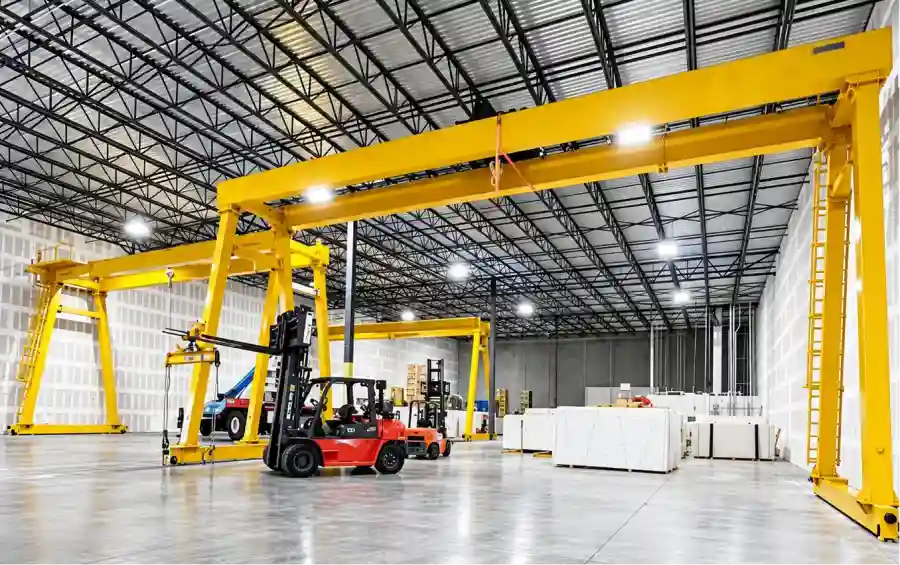
However, the supporting legs occupy floor space. If your warehouse aisles are narrow or forklifts operate continuously around the crane area, this needs to be considered carefully during layout design.
Fixed Rail Gantry Crane or Mobile Gantry Crane?
Not every warehouse gantry crane works in the same way.
For heavier or more frequent material handling, a rail-mounted gantry crane is generally the more suitable configuration. The crane travels along rails installed on the warehouse floor, providing a defined and repeatable working path.
For lighter maintenance, assembly, or occasional lifting, a mobile gantry crane may be more convenient. These cranes can be repositioned around the workshop or warehouse instead of being permanently tied to one runway.
The choice depends on questions such as:
How heavy is the load?
How often will the crane operate?
Does the load need to travel a long distance?
Does the crane need to stay in one working zone?
Can rails be installed on the warehouse floor?
These operating details are often more important than simply comparing crane prices.
Single Girder or Double Girder?
The bridge configuration is another important decision.
A single-girder warehouse gantry crane can be suitable for many general material-handling applications where the required capacity, span, lifting height, and duty conditions fall within an appropriate range.
A double-girder gantry crane may be considered when the application requires a heavier lifting capacity, larger span, demanding duty, or a configuration that benefits from a more robust bridge arrangement.
The correct option should be based on engineering requirements rather than assuming that double girder is always better.
For many warehouse users, the most cost-effective crane is simply the one that safely matches the real working condition without unnecessary structural complexity.
Pay Attention to Warehouse Floor Conditions
One detail that can easily be overlooked is the floor.
A gantry crane transfers loads through its legs and wheels to the supporting surface. For a rail-mounted crane, rail foundations and wheel loads must therefore be considered during project planning.
An existing concrete floor should not automatically be assumed suitable for crane installation.
Before finalizing the design, the supplier and customer should confirm information such as the crane layout, rail position, foundation conditions, and allowable loads.
This becomes particularly important for larger cranes or warehouses that were not originally designed for heavy lifting equipment.
Think About Forklifts, Racks, and People
Warehouse crane selection is not only a mechanical question. It is also a traffic-planning question.
A crane may technically fit inside a building but still create problems if its legs interfere with forklift lanes, loading doors, pallet storage, workstations, or pedestrian areas.
Before purchasing, mark the proposed crane travel path directly on the warehouse layout.
Check where the crane legs will move and whether they may conflict with:
-storage racks;
-forklifts;
-trucks;
-production machines;
-doors;
-columns;
-work platforms;
-pedestrian routes.
This simple layout check can prevent expensive changes after manufacturing.
Hoist and Control Options Should Match the Job
The hoisting system should also match the way operators handle materials.
Different projects may require different lifting and travelling arrangements depending on load characteristics, positioning accuracy, operating frequency, and working environment.
Control method is another point to discuss with the supplier.
The most suitable configuration depends on how operators need to move around the load, how large the working area is, and how the warehouse is organized.
Rather than asking for every available feature, explain how the crane will actually be used. A supplier can then recommend the appropriate configuration for the application.
What Information Should You Send for a Warehouse Gantry Crane Quote?
A clear inquiry usually leads to a faster and more accurate quotation.
When contacting a crane supplier, provide as much of the following information as possible:
-required lifting capacity;
-required span;
-lifting height;
-crane travel length;
-indoor working environment;
-approximate daily working hours;
-typical number of lifting cycles;
-material or equipment being lifted;
-available warehouse height;
-warehouse width and column spacing;
-preferred travelling arrangement;
-power supply information;
-photos or drawings of the installation area.
If some dimensions are not confirmed yet, a warehouse layout drawing is often very helpful.
The supplier can review the available space and discuss which dimensions still need to be measured.
A Simple Example of Crane Selection
Imagine a warehouse where heavy machine components must be transferred between a storage area and an assembly station.
The building already exists, and there is no overhead crane runway.
In this situation, the buyer should first identify the required working zone rather than immediately choosing a crane model.
The next steps would be to determine the maximum load, measure the width of the operating area, confirm the required hook height, check the available roof clearance, and examine whether crane rails can be installed without blocking forklift traffic.
Only after these points are clear should the final crane configuration be selected.
This approach is much safer than starting with a question such as, “How much is a 10-ton gantry crane?” because two cranes with the same rated capacity can have completely different spans, heights, duties, structures, and installation requirements.
Before Buying, Focus on the Application Instead of the Crane Name
A warehouse gantry crane is not a standard product that should be selected by lifting capacity alone.
The right crane depends on the relationship between the load, warehouse dimensions, operating frequency, floor conditions, material flow, and available working space.
For buyers planning a new lifting system, the most useful first step is to prepare the basic working parameters and a simple warehouse layout.
With that information, the crane supplier can evaluate whether a fixed rail gantry crane, mobile gantry crane, single-girder design, double-girder design, or another lifting solution is more suitable.
If you are requesting a quotation, send the lifting capacity, span, lifting height, travel length, warehouse dimensions, and operating frequency first. These details are usually enough to begin a practical technical discussion and narrow down the correct warehouse gantry crane configuration.
