



What a Manual Single‑girder Bridge Crane Actually Is?
A manual single‑girder bridge crane is an overhead lifting system where the trolley moves along one main beam, and both the trolley and the bridge are moved by hand‑pulled chain or manual push. The hoist is the only motorised component. There is no VFD, no travel motor, no motorised end carriage, and no control panel for bridge or trolley movement.
This is not a stripped‑down version of an electric crane. It is a different product category, designed for a specific operating profile: low‑frequency lifts, minimal electrical infrastructure, and a budget that cannot absorb full‑electric overhead crane cost.
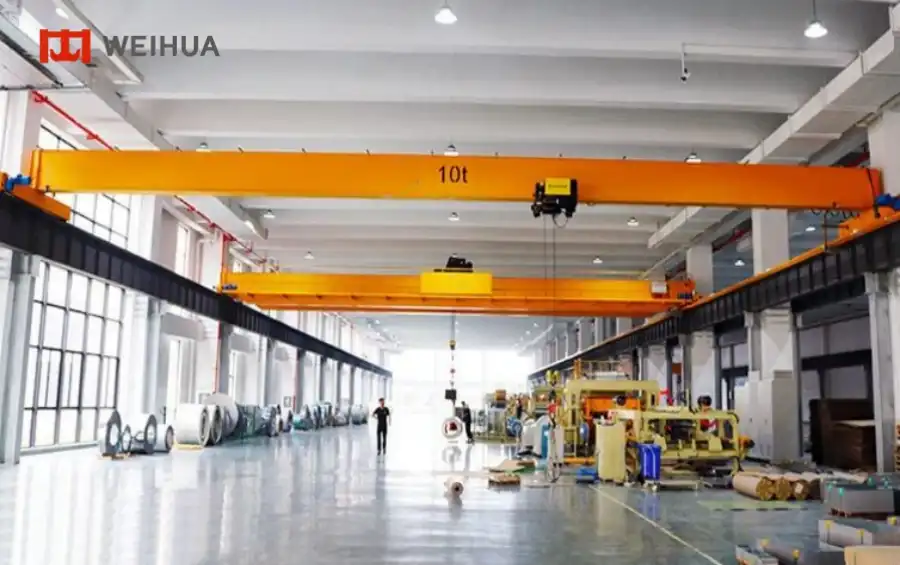
CD‑Type Wire Rope Hoist – the Only Motorised Part
The hoist on a manual single‑girder bridge crane is typically a CD‑type wire rope electric hoist mounted on a manual trolley. It is the same hoist model used on many light‑duty electric cranes, but here it runs on a hand‑pushed trolley rather than a motorised one.
What the supplier should specify:
•Hoist type: CD‑type wire rope hoist
•Lifting speed: 8 m/min single speed, or 8/0.8 m/min dual speed for precise load placement
•Motor insulation: Class F (standard) or Class H (required for tropical / high‑humidity workshops)
•Protection rating: IP54 for indoor installation; IP55 or higher if the hoist is exposed to dust or moisture
•Duty classification: M3 to M4 (ISO 4301 / FEM 1.001) is sufficient for manual‑operation duty cycles. M5 only if the buyer anticipates future frequency increase
What the CD‑Type Hoist Does Differently in a Manual Crane?
Because the trolley is hand‑pushed, the hoist is not subject to the same acceleration and braking forces as in a motorised trolley. This reduces wear on the trolley wheels and the hoist housing. A CD‑type hoist on a manual crane typically reaches 8–10 years of service before major overhaul, compared to 5–7 years in a full‑electric crane operating at the same capacity.
Main Girder – What Changes When Travel Is Manual
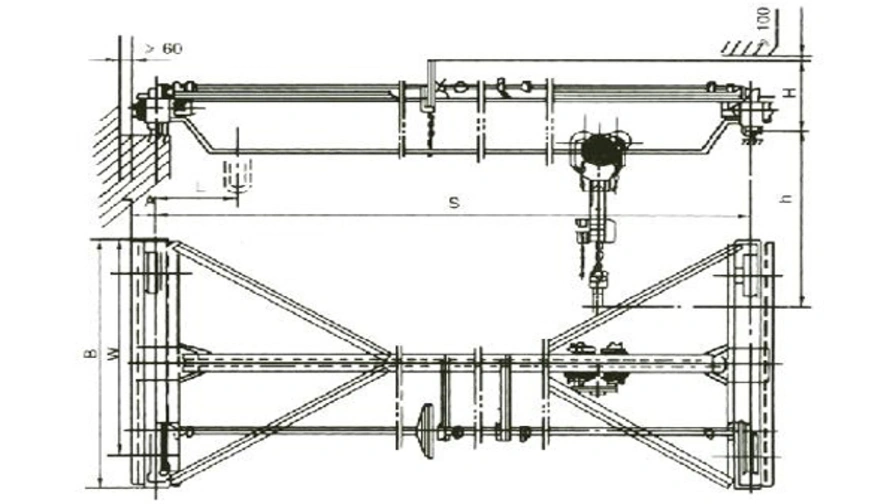
The single girder on a manual bridge crane is structurally similar to that of an electric crane, but without a motorised trolley, the girder does not need to accommodate a control panel or cable tray along its length. This simplifies the girder profile and reduces the overall weight of the crane.
Girder specs:
•Material: Q235B or Q345B carbon steel (GB/T 1591)
•Section type: I‑beam or box section, with pre‑set camber to offset full‑load deflection
•Deflection limit: ≤ 1/800 of span at rated load (ISO 4301, GB/T 3811)
•Span range: 5 m to 20 m
•Transport: For spans over 12 m, the girder is cut into two sections, shipped in a 20‑ft or 40‑ft container, and re‑joined on site with bolted connection plates
Why deflection matters for a manual crane: A girder that deflects excessively under load creates rolling resistance on the hand‑pushed trolley. The operator has to push harder. A properly cambered girder keeps the trolley travel smooth even when the crane is loaded. This is a detail that directly affects daily usability, not just a compliance checkbox.
When to Specify a Manual Crane – and When Not To?
Right‑Fit Applications
•Maintenance bays where the primary task is lifting engines, pumps, or machine parts out of equipment. Lifts are infrequent, and speed is not critical.
•Small fabrication shops where the crane is used to load and unload raw materials from a truck or staging area, not to feed a production line.
•Warehouses handling palletised goods on a push‑pull basis. The operator can move the load manually while walking alongside it.
•Facilities with limited electrical capacity — a manual crane adds only the hoist load to the workshop power budget.
•Projects with a hard cost ceiling where the buyer needs a genuine overhead crane (not a gantry or a hoist‑only setup) but cannot justify the cost of a full‑electric system.
Not Recommended
•High‑frequency production lines — more than 20 lifts per hour. Manual travel becomes fatiguing for the operator.
•Regular loads above 10 t — the manual push effort increases disproportionately with load.
•Precision positioning at speed — the operator cannot control direction and speed as precisely as with a VFD‑equipped motorised trolley.
•Full‑shift continuous operation — operator fatigue becomes a safety and productivity issue.
Applicable Standards
Design standards:
•GB/T 3811 (China) – Crane design specification
•ISO 4301 – Crane classification
•FEM 1.001 (Europe) – Crane design rules
Safety standards:
•GB/T 14405 – General purpose overhead crane
•EN 15011 – Bridge and gantry cranes (European standard)
•IEC 60204-32 – Electrical safety of machinery
•2006/42/EC – CE Machinery Directive (if exporting to Europe)
Standard safety devices included:
•Lifting limit switch
•Emergency stop button (on hoist pendant)
•Overload limiter (cuts hoist power if load exceeds 110% of rated capacity)
•End‑travel buffers (rubber or polyurethane stoppers on rail ends)
•Hoist warning horn
Factory Acceptance Test: The supplier should perform a 125% rated‑load static test and a no‑load running test on all mechanisms before shipment. Ask for a test certificate.
Cost – What a Manual Crane Actually Costs
A manual single‑girder bridge crane costs 40–60% less than an equivalent electric‑travel crane. The cost saving comes from:
•No travel motors, VFDs, or control panels for trolley and bridge movement
•Simpler end carriage design (no motor mounts, gearboxes, or travel brakes)
•Lower installation cost (fewer electrical connections, no travel‑motor commissioning)
•Fewer moving parts under maintenance
Reference price (FOB Qingdao, excluding rail and freight):
•5 t, 17 m span: USD 8,000–10,000
•Adding rail, busbar, cable reel, and sea freight to a major African or Middle Eastern port (CIF): approximately USD 12,000–15,000
Frequently Asked Questions
Q1: Can I upgrade a manual single‑girder bridge crane to electric travel later?
Yes, if the end carriages are supplied with pre‑drilled motor mounting holes and a busbar system is installed during initial setup. The upgrade cost is significantly lower than buying a new electric crane, but it must be planned from the beginning. Retrofitting to an end carriage that was not designed for motors is not economical.
Q2: What is the maximum span for a manual single‑girder bridge crane?
Most suppliers will manufacture up to 20 m. Beyond that, the beam weight makes manual pushing too difficult and a motorised system is recommended.
Q3: Can it be used outdoors?
Yes, with IP55 or higher protection on the hoist and electrical components, anti‑corrosion paint on the steel structure, and wind load calculation for the load. Without these, outdoor use will accelerate wear and create safety risks.
Q4: What safety devices are included as standard?
Lifting limit switch, emergency stop, overload limiter, end‑travel buffers, and a hoist warning horn. These are included in the standard package.
Q5: How long does the hoist last in a manual crane?
A CD‑type wire rope hoist on a manual crane, with regular lubrication, brake inspection, and wire rope replacement per schedule, typically reaches 8–10 years before major overhaul. The manual‑travel configuration reduces shock loads on the hoist housing compared to motorised trolley operation.
